
Laboratory Preparation of Nitrogen
Laboratory Preparation of Nitrogen
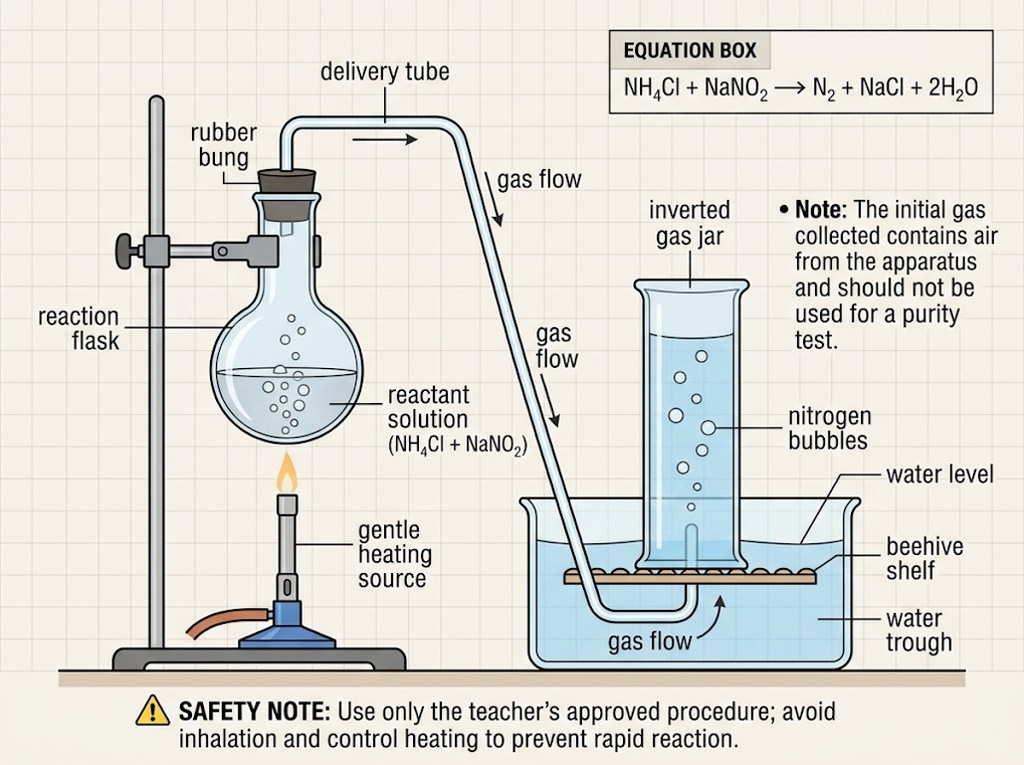
Nitrogen may be prepared in the laboratory by removing oxygen and other reactive components from air, or through a suitable chemical reaction selected for the school laboratory. A common textbook approach involves warming a solution containing ammonium chloride and sodium nitrite, which forms ammonium nitrite in situ; ammonium nitrite decomposes to nitrogen and water. This procedure must be carried out only with teacherapproved quantities and apparatus.
Simplified equations: NH₄Cl + NaNO₂ → NH₄NO₂ + NaCl; then NH₄NO₂ → N₂ + 2H₂O. The overall reaction is NH₄Cl + NaNO₂ → N₂ + NaCl + 2H₂O. Actual laboratory instructions may use a different approved preparation method.
Nitrogen can be collected over water because it is only slightly soluble and does not react significantly with water under ordinary collection conditions. The first portion of gas should be treated as contaminated by air in the apparatus.
Testing nitrogen
Nitrogen does not relight a glowing splint and does not support ordinary combustion. However, this test alone cannot positively identify nitrogen because several other gases also fail to support combustion. Reliable identification may require knowing how the gas was prepared and excluding other gases through the experimental procedure.
Why the first gas is often discarded
Before gas production begins, the flask and delivery tube contain air. The first gas emerging from the apparatus is therefore a mixture of the prepared gas and the original air. Allowing the initial mixture to escape helps reduce contamination of the collected sample. This principle applies to many gas-preparation experiments.
Boyle’s Law
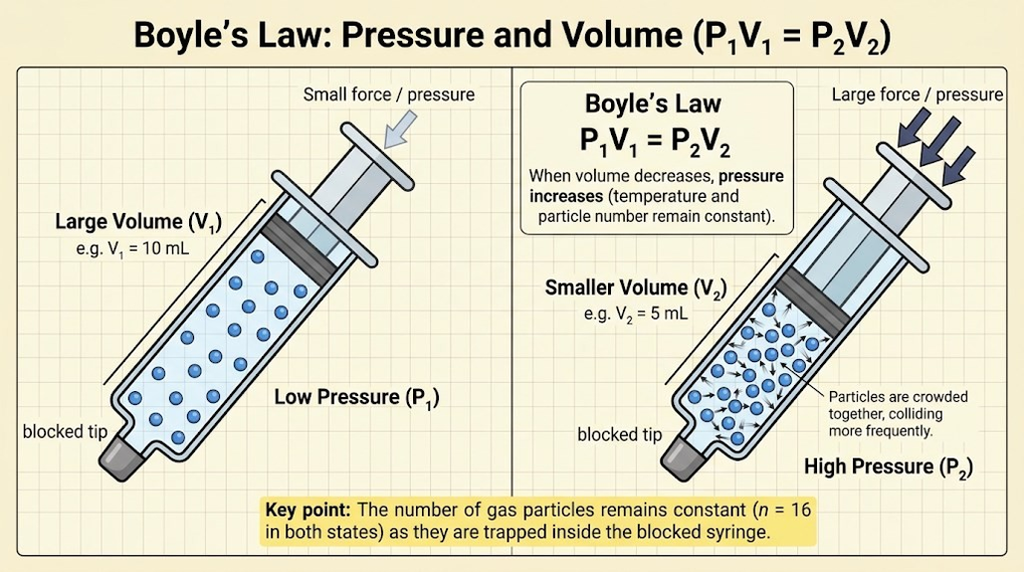
For a fixed amount of gas at constant temperature, pressure is inversely proportional to volume. When volume decreases, wall collisions become more frequent and pressure increases. Equation: P₁V₁ = P₂V₂.
- Use identical pressure units and identical volume units for both states.
- Temperature and amount of gas must remain constant.
- Applications include a syringe with its nozzle blocked.
Worked Example 11: Boyle’s law
Problem. A gas occupies 600 cm³ at 100 kPa. Find volume at 150 kPa at constant temperature.
Step 1: Use P₁V₁ = P₂V₂.
Step 2: V₂ = (100 × 600)/150 = 400 cm³.
Answer. The volume is 400 cm³.
