ECOLOGY
Ecology is the study of relationships between organisms and their living and non-living environments. Ecological knowledge helps explain how organisms survive in different habitats, how populations are distributed, how nutrients move through ecosystems and how human activities affect environmental quality.
Ecosystems and their components
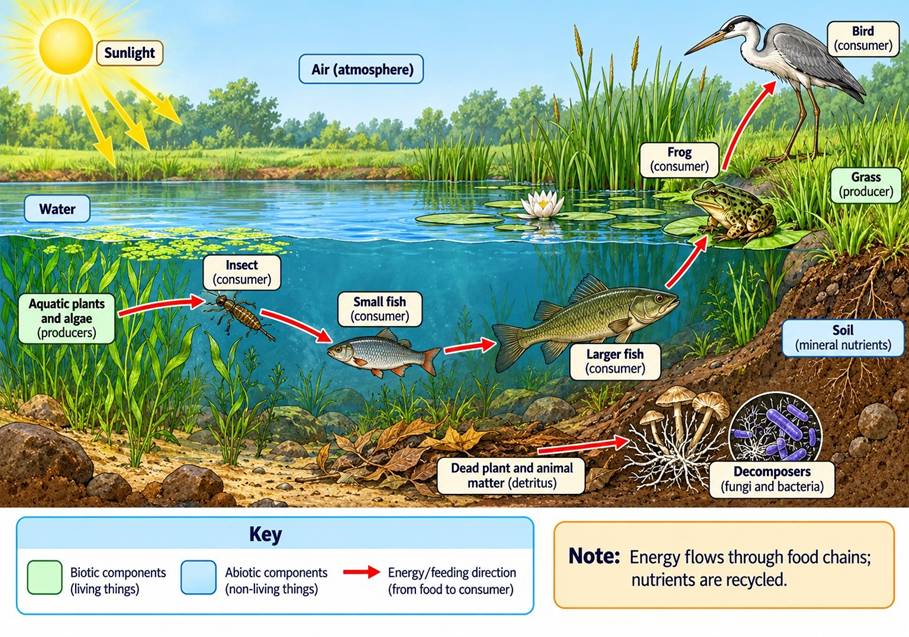
An ecosystem consists of a community of organisms interacting with one another and with the non-living environment in a particular area. A pond, forest patch, grassland, river, mangrove swamp, coral reef or cultivated field can be studied as an ecosystem. Ecosystems have boundaries chosen for study, but matter and organisms may move across those boundaries.
The living components are called biotic factors. They include producers, consumers, decomposers, parasites, predators, prey and competitors. The non-living components are abiotic factors, including light intensity, temperature, water availability, pH, salinity, dissolved oxygen, soil texture, mineral nutrients and wind. These factors interact: for example, light influences photosynthesis, while soil water affects plant growth and the availability of food and shelter for animals.
Major ecological terms
- Organism: an individual living thing, such as one grass plant.
- Species: a group of organisms sharing defining characteristics; in the biological species concept, members can interbreed and produce fertile offspring.
- Population: members of the same species living in a defined area at a given time.
- Community: populations of different species living and interacting in an area.
- Habitat: the place where an organism lives.
- Niche: the role of an organism in its ecosystem, including resource use and interactions.
- Ecosystem: the community and its abiotic environment interacting as a system.
- Biosphere: the global zone of life, comprising all ecosystems.
Energy generally enters most ecosystems through sunlight captured by photosynthetic producers. Energy passes through feeding relationships and is dissipated as heat, so it is not recycled in the same way as chemical nutrients. Nutrients such as carbon and nitrogen cycle between organisms and the environment.
Terrestrial ecosystems occur on land. Their conditions are influenced by rainfall, temperature, soil, altitude and vegetation. Examples include savannah, woodland, forest, grassland, desert and agricultural ecosystems. Kenyan savannah ecosystems may support grasses, acacia trees, herbivores, predators, insects and decomposers, with seasonal changes in water availability influencing population sizes and movement.
Freshwater ecosystems have low concentrations of dissolved salts compared with marine environments. They include rivers, streams, lakes, ponds, wetlands and reservoirs. Flow rate, depth, light penetration, temperature, dissolved oxygen and nutrient levels affect which organisms thrive. Fast-flowing water favours organisms able to cling to surfaces or swim against currents, while still water may support plankton, rooted plants and different invertebrates.
Marine ecosystems include oceans, coastal waters, estuaries, mangroves, seagrass beds and coral reefs. Salinity, tides, waves, depth and light are important factors. Estuaries mix freshwater and seawater and can be highly productive. Mangroves provide nursery habitats, trap sediments and reduce shoreline erosion; coral reefs support diverse communities but are sensitive to warming, pollution and physical damage.
Adaptations of organisms to habitats
An adaptation is an inherited structural, physiological or behavioural feature that improves an organism’s ability to survive and reproduce in a particular environment. Adaptations do not arise because an individual deliberately needs them; populations change over generations as inherited variations affect survival and reproduction. A feature that is advantageous in one environment may be less useful in another.
Reproduction in Animals
Reproduction is the biological process through which organisms produce new individuals of their own kind. It maintains the continuity of a species across generations. The curriculum expects learners to explain reproduction in animals, distinguish fertilisation types, relate reproductive structures to functions, describe the menstrual cycle and the roles of hormones, explain fertilisation, pregnancy, birth and lactation in humans, and appreciate biotechnology in reproductive health.
Meaning and Importance of Reproduction
Reproduction is not required for an individual animal to remain alive in the short term, but it is essential for the continuation of a species. Without successful reproduction, a population eventually declines as individuals die and are not replaced.
- It maintains the population and prevents the species from disappearing.
- Sexual reproduction creates genetic variation among offspring, which can improve the ability of a population to respond to environmental change.
- Reproductive behaviour may include courtship, territorial behaviour, mating calls, displays or parental care. Reproductive success depends on the production of viable gametes or offspring, successful fertilisation where it occurs, suitable conditions for embryonic development, and survival to reproductive age.
Asexual and Sexual Reproduction
Asexual reproduction involves one parent and does not involve the fusion of male and female gametes. Offspring are usually genetically very similar to the parent, apart from mutations. Sexual reproduction involves the formation and fusion of gametes, usually from two parents, producing a zygote.
Some animals can reproduce asexually under certain conditions. In budding, a new individual grows as an outgrowth on the parent and may later separate. In fragmentation, a body part develops into a complete individual in species capable of this process. These methods should not be confused with ordinary cell division for growth or tissue repair.
Gametes and Fertilisation
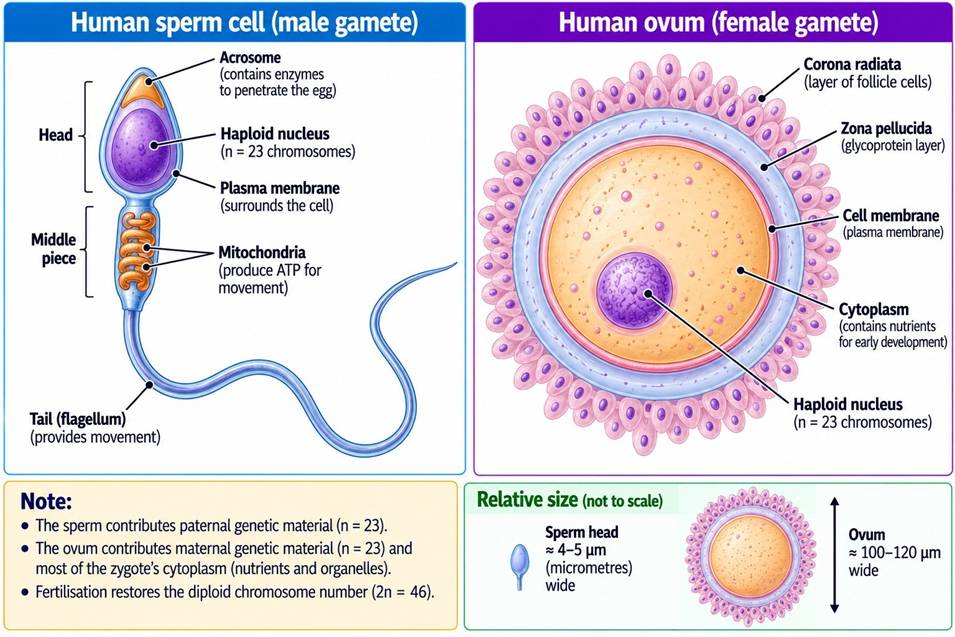
A gamete is a specialised reproductive cell. In animals, the male gamete is commonly the sperm cell and the female gamete is the ovum or egg cell. Fertilisation is the fusion of the nuclei of male and female gametes to form a diploid zygote. In many animals, the zygote divides repeatedly by mitosis and develops into an embryo.
Sperm cells are adapted for movement and delivery of genetic material. In mammals, the head contains a haploid nucleus and an acrosome with enzymes that assist penetration of the egg coverings; the middle piece contains many mitochondria; and the tail propels the cell. The ovum is larger, contains a haploid nucleus and cytoplasm, and has protective coverings.