Refraction of Light
Learning focus: explain refraction of light, verify the laws of refraction, determine refractive indices, describe total internal reflection and its applications, and relate optical principles to everyday life.
Refraction is a change in the direction of propagation of light when it passes obliquely from one transparent medium into another because its speed changes. A medium is a material through which light travels, such as air, water, glass or transparent plastic. Refraction explains why a straight object partly immersed in water may appear bent, why a swimming pool can appear shallower than it really is, and how lenses focus light to form images.
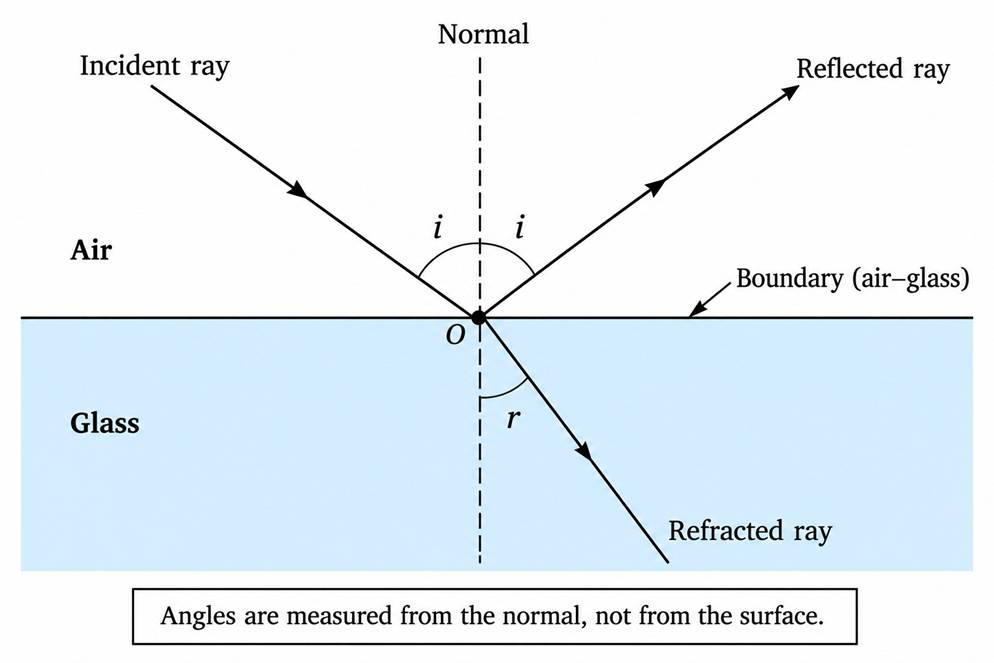
Refraction is not simply a change in direction: the speed and wavelength change when light enters a different medium, while the frequency remains constant at the boundary. If a ray enters the new medium along the normal, its speed still changes but its direction does not. This distinction is important in both diagrams and explanations.
Light as a Ray and the Normal
In geometrical optics, a ray is a straight line with an arrow showing the direction in which light energy travels. Rays are useful models when the objects and openings involved are much larger than the wavelength of visible light. A ray diagram does not show the full wave nature of light; it simplifies the path so that angles and image formation can be analysed.
The normal is an imaginary line drawn perpendicular (at 90°) to the boundary between two media at the point where the incident ray meets the surface. The angle of incidence, i, is measured between the incident ray and the normal, not between the ray and the surface. The angle of refraction, r, is measured between the refracted ray and the normal in the second medium. The reflected ray, if shown, also has its angle measured from the normal.
A common error is to measure angles from the boundary. If a ray makes 30° with the surface, its angle with the normal is 60°. Always draw the normal before labelling angles.
Apparent Depth and Apparent Displacement
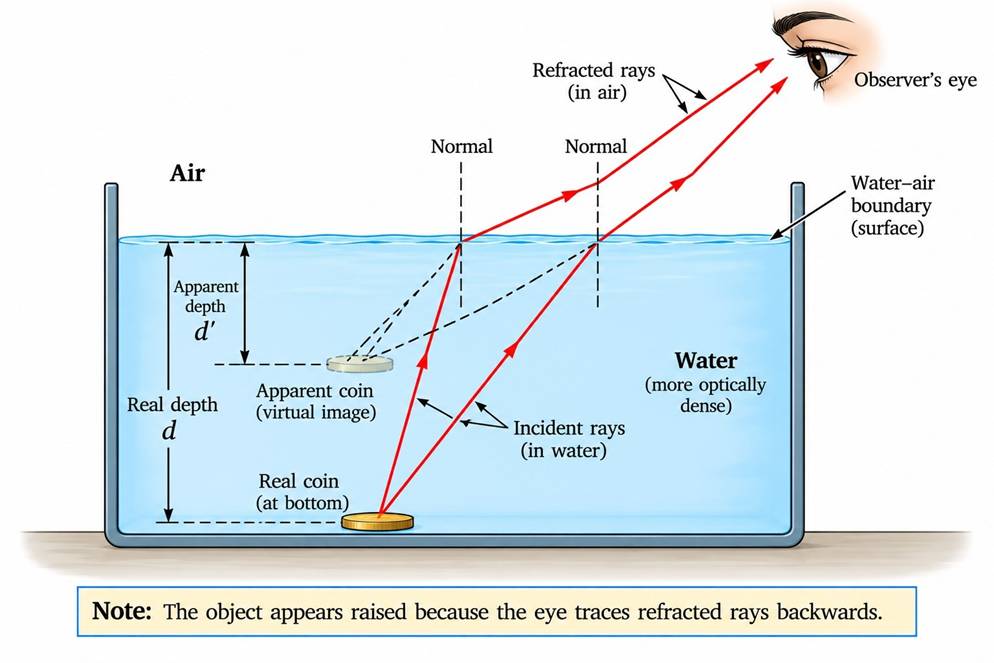
An object under water often appears nearer to the surface than it really is when viewed from air. Light from the object travels from water into air and bends away from the normal. The eye assumes that light has travelled in straight lines and traces the emerging rays backwards. The backward extensions meet at a virtual image above the actual object. This image is called the apparent position.
For near-normal viewing from air into water, the apparent depth is approximately: apparent depth = real depth / refractive index of water
This approximation works best for viewing close to the normal and for a flat boundary. It is not exact for large viewing angles. The difference between real and apparent depth is called apparent displacement.
The phenomenon has practical importance when judging the depth of swimming pools, rivers and containers. A person should not assume a pool is safe to dive into simply because it looks shallow or clear. The apparent position is not the actual position.
Capacitors
Curriculum focus: electric fields and patterns; charge between capacitor plates; factors affecting capacitance; charging and discharging of capacitors; and applications of capacitors. The learning emphasis is on explaining how a capacitor stores charge and energy, investigating the effect of changing its physical features, and applying capacitor principles to real situations.
What is a capacitor?
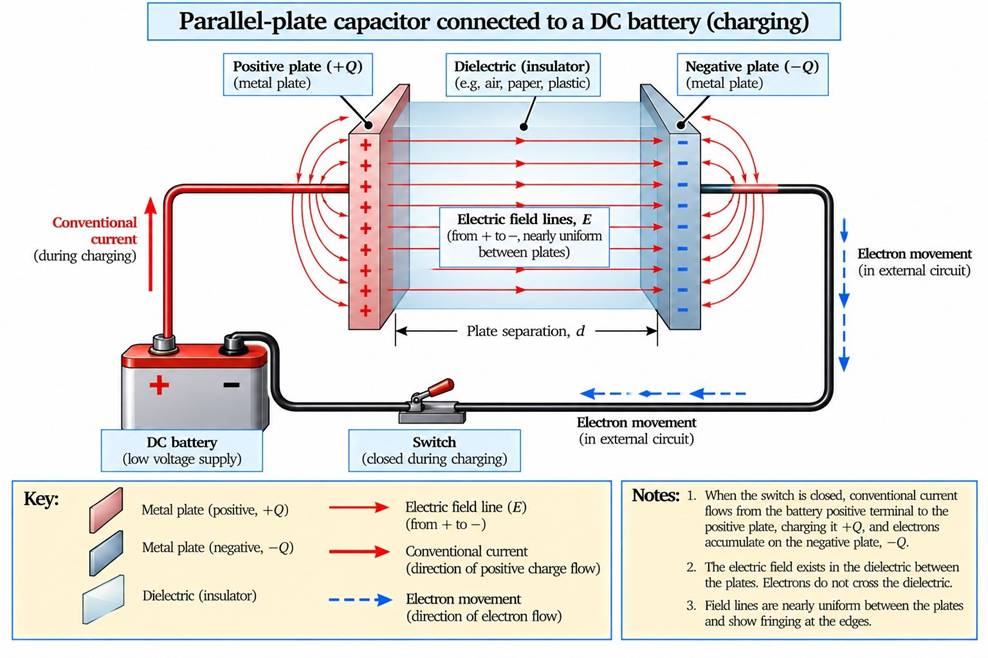
A capacitor is an electrical component designed to store separated electric charge and energy in an electric field. A basic capacitor consists of two conducting surfaces separated by an insulating material called a dielectric. The conductors are often called plates, although practical capacitors may use rolled metal foils, thin films or other geometries rather than flat plates.
When a capacitor is connected to a battery, electrons are moved from one conductor to the other through the external circuit. One conductor gains excess electrons and becomes negatively charged; the other loses electrons and becomes positively charged. The two conductors acquire equal magnitudes of charge, +Q and −Q, provided the capacitor is initially neutral and there is no leakage to the surroundings. The insulating gap prevents charge from crossing directly between the conductors.
A capacitor does not normally create charge. It separates charge using energy supplied by the source. When the source is removed, the capacitor may retain charge for some time, depending on the insulation and the connected circuit. A charged capacitor can therefore deliver a brief current even after it has been disconnected from a battery.
- Conducting plates: surfaces on which charge accumulates.
- Dielectric: insulating material between the conductors; it prevents direct conduction and can increase capacitance.
- Terminals: the external connections through which a capacitor is charged or discharged.
- Electric field: the field established in the region between oppositely charged conductors.
Magnetism and magnetic fields
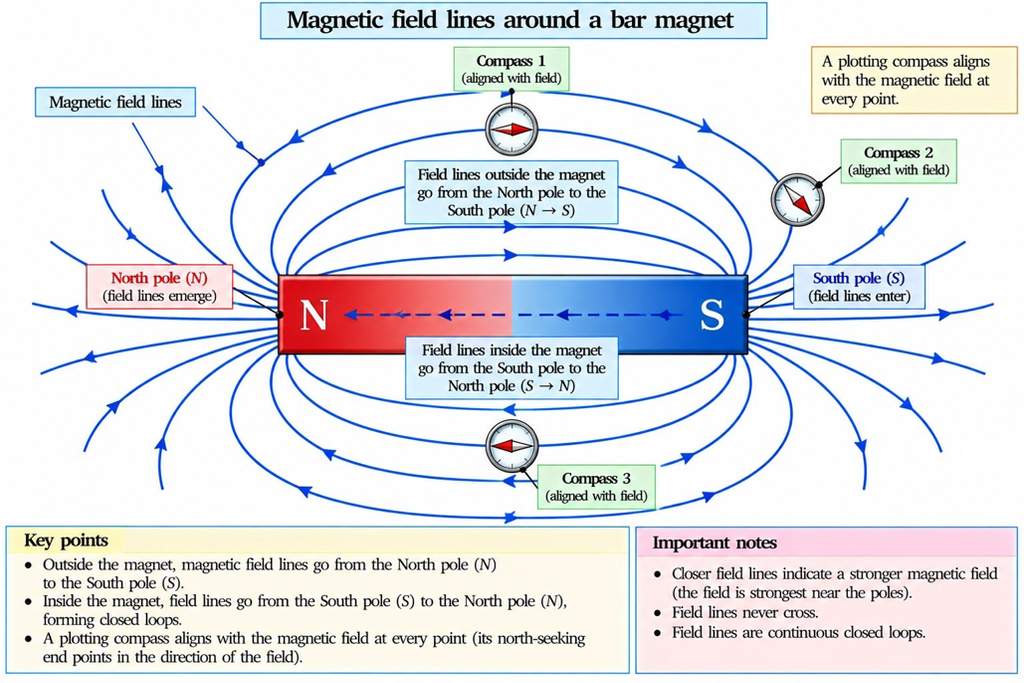
A magnet produces a magnetic field in the space around it. A magnetic field is a region where a magnetic pole, a moving charge or a current-carrying conductor experiences a magnetic force. Magnetic fields are represented by field lines. Outside a bar magnet, field lines are drawn from the north pole to the south pole; inside the magnet, they continue from south to north, forming closed loops.
Field lines are a model rather than physical threads. Their direction at a point is the direction a north-seeking pole would be pushed. Closer field lines represent a stronger field. Field lines never cross because the magnetic field at a point has one definite direction.
Magnetic materials include iron, nickel, cobalt and many alloys. Materials differ in how strongly they respond to a magnetic field. A permanent magnet retains much of its magnetisation, while a soft iron core is readily magnetised and demagnetised, making it useful in electromagnets.